

When purchasing natural stone, buyers often notice that bigger marble slabs carry higher prices per square foot. However, many wonder why slab size affects pricing when the material remains the same.
The answer involves stone rarity, production costs, transportation, and material wastage. Moreover, large marble slabs provide greater design flexibility and visual continuity.
Understanding these factors helps homeowners, architects, and contractors make informed purchasing decisions.

1. Large Marble Slabs Are Naturally Rare
Natural marble comes from large stone blocks extracted from quarries. However, not every block produces oversized slabs.
Many blocks contain cracks, veins, or structural weaknesses. Consequently, manufacturers must carefully select suitable blocks for large-format cutting.
Additionally, some premium marble varieties offer limited quantities of large, structurally sound slabs.
Therefore, bigger slabs often command higher prices because suitable raw blocks are harder to obtain.
2. Bigger Marble Slabs Require Specialized Cutting
Cutting large marble slabs requires precision machinery and careful handling.
Moreover, oversized blocks demand stable cutting conditions to reduce breakage risks.
Manufacturers must also maintain consistent thickness throughout the slab. Otherwise, uneven cutting may affect finishing quality and installation.
As a result, specialized processing and additional handling increase production expenses.
3. Higher Wastage Increases Marble Slab Prices
Material wastage significantly influences marble pricing.
During production, manufacturers remove damaged edges, cracks, and unsuitable sections. However, producing larger uninterrupted slabs may require rejecting more material.
For example, a smaller slab can sometimes be recovered from an imperfect stone block.
In contrast, an oversized slab needs a larger continuous area without serious defects.
Therefore, manufacturers may charge more per square foot to recover production losses.
4. Large Marble Slabs Increase Transportation Costs
Transporting oversized marble slabs requires additional planning and protective equipment.
Large slabs need suitable lifting machinery, secure packaging, and experienced handlers. Furthermore, improper loading can cause cracks or edge damage.
Transportation expenses also depend on slab dimensions, thickness, weight, and delivery distance.
Consequently, large-format slabs may cost more to deliver safely than smaller alternatives.
5. Premium Marble Slabs Offer Better Design Continuity
Large marble slabs create a luxurious appearance across floors, walls, and feature installations.
Because larger slabs cover more surface area, designers can reduce visible joints.
Additionally, natural veins can flow across wider surfaces without frequent interruptions.
This advantage makes oversized slabs attractive for premium residential and commercial projects.
For example, Italian marble often features distinctive natural patterns.
Therefore, larger slabs can offer greater aesthetic value, particularly when consistent veining matters.
6. Handling and Installation Require Extra Care
Installing bigger marble slabs demands experienced workers and suitable lifting equipment.
Moreover, oversized slabs can be difficult to maneuver through narrow entrances and staircases.
Installers must also prepare level surfaces and select appropriate fixing materials.
In some projects, larger slabs require additional workers or mechanical lifting assistance.
Consequently, buyers should consider installation expenses alongside the slab purchase price.
7. Premium Demand Influences Large Marble Slab Prices
Luxury villas, hotels, showrooms, and commercial buildings often require oversized natural stone slabs.
These projects frequently prioritize visual continuity, distinctive patterns, and fewer joints.
As a result, demand for premium large-format marble can influence market pricing.
However, slab dimensions alone do not determine value.
Stone quality, thickness, finish, origin, and availability also affect the final price.
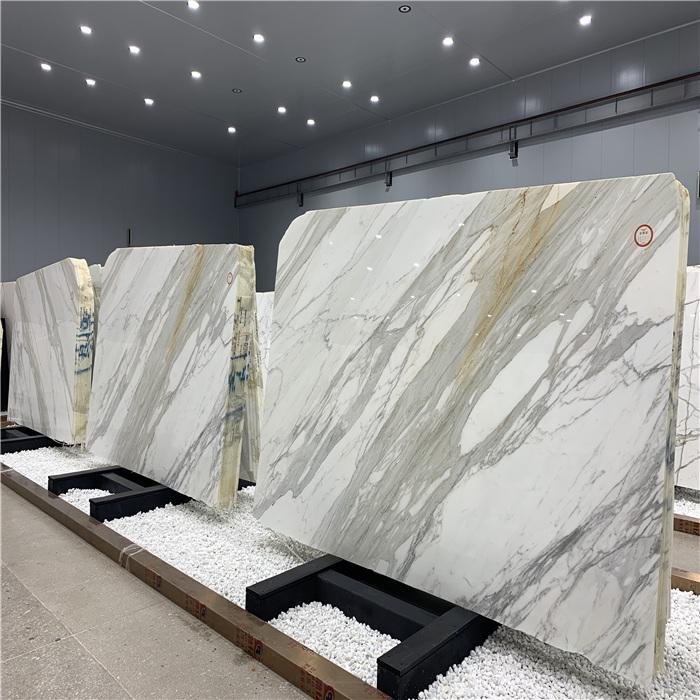
Large Marble Slabs vs Small Marble Slabs: Price Comparison
| Feature | Bigger Marble Slabs | Smaller Marble Slabs |
|---|---|---|
| Price per sq. ft. | Often higher | Often lower |
| Raw material availability | More limited | Generally wider |
| Cutting requirements | More demanding | Easier to manage |
| Handling | Specialized equipment may be needed | Usually simpler |
| Visible joints | Fewer | More |
| Design appearance | Broad, continuous patterns | More segmented patterns |
| Installation | Requires careful planning | Generally more flexible |
Although bigger slabs offer aesthetic benefits, smaller slabs may provide better value for compact projects.
Therefore, buyers should choose slab dimensions according to their design requirements and budget.
Expert Insight by Ankit Singhal
Author of The Secrets of the Marble Industry
“When buying marble, compare more than the square-foot rate. Evaluate slab dimensions, usable area, stone quality, and installation requirements.”
A larger slab does not automatically guarantee better quality.
Instead, buyers should examine natural cracks, surface finish, thickness, and overall material condition.
Additionally, they should calculate cutting losses before finalizing the purchase.
This practical approach helps prevent unnecessary expenses.
How to Choose the Right Marble Slab Size
Before purchasing natural stone, measure the installation area accurately.
Next, consider the direction of natural veins and the number of visible joints.
Furthermore, request actual slab photographs or inspect the material personally.
Finally, compare total project costs, including cutting, transportation, polishing, and installation.
For larger projects, consult an experienced marble supplier before confirming slab sizes.
Conclusion
Bigger marble slabs often cost more per square foot because suitable stone blocks are less common.
Additionally, cutting complexity, material wastage, transportation, and handling contribute to higher prices.
However, large slabs can deliver exceptional visual continuity and fewer installation joints.
Ultimately, the right slab size depends on project requirements, stone quality, and overall budget.
Explore premium marble and granite collections at Stone Expert.
Frequently Asked Questions (FAQs)
1. Why are bigger marble slabs more expensive?
Bigger slabs often cost more because suitable stone blocks are rarer. Additionally, cutting, handling, and transportation can increase costs.
2. Do bigger marble slabs have better quality?
Not necessarily. Marble quality depends on stone structure, finish, thickness, and natural defects rather than size alone.
3. What are common Italian marble slab sizes?
Common listed sizes include 7 × 5 feet, 8 × 6 feet, and 10 × 6 feet.
4. Are large marble slabs suitable for flooring?
Yes. Larger slabs can create continuous flooring patterns with fewer visible joints.
5. Can larger marble slabs reduce wastage?
Yes, when dimensions match the installation area. However, poorly planned cutting can increase wastage.
6. Where can I buy premium large marble slabs in Kishangarh?
Explore the Italian marble collection at Stone Expert for slab options and project requirements.
Explore Our Marble Collections
| Marble Collection | Website Link |
|---|---|
| Italian Marble | Stone Expert – Italian Marble |
| Imported Marble | Stone Expert – Imported Marble |
| Premium Italian Marble | Shree Ram Stones – Italian Marble |
| Imported Marble Varieties | Shree Ram Stones – Imported Marble |
| Statuario, Calacatta and Carrara | Compare Italian White Marble |
Contact Stone Expert – Premium Marble Supplier in Kishangarh
STONE EXPERT
PREMIUM MARBLE & GRANITE | KISHANGARH, RAJASTHAN
Visit Our Marble Showroom
Makrana Road, RIICO Industrial Area, Kishangarh, Khatoli, Rajasthan – 305801, India
Call or WhatsApp
+91 92521 01111
Email Our Team
ceo@shreeramexpo.in
shreeramexpo@gmail.com
Explore Our Websites