
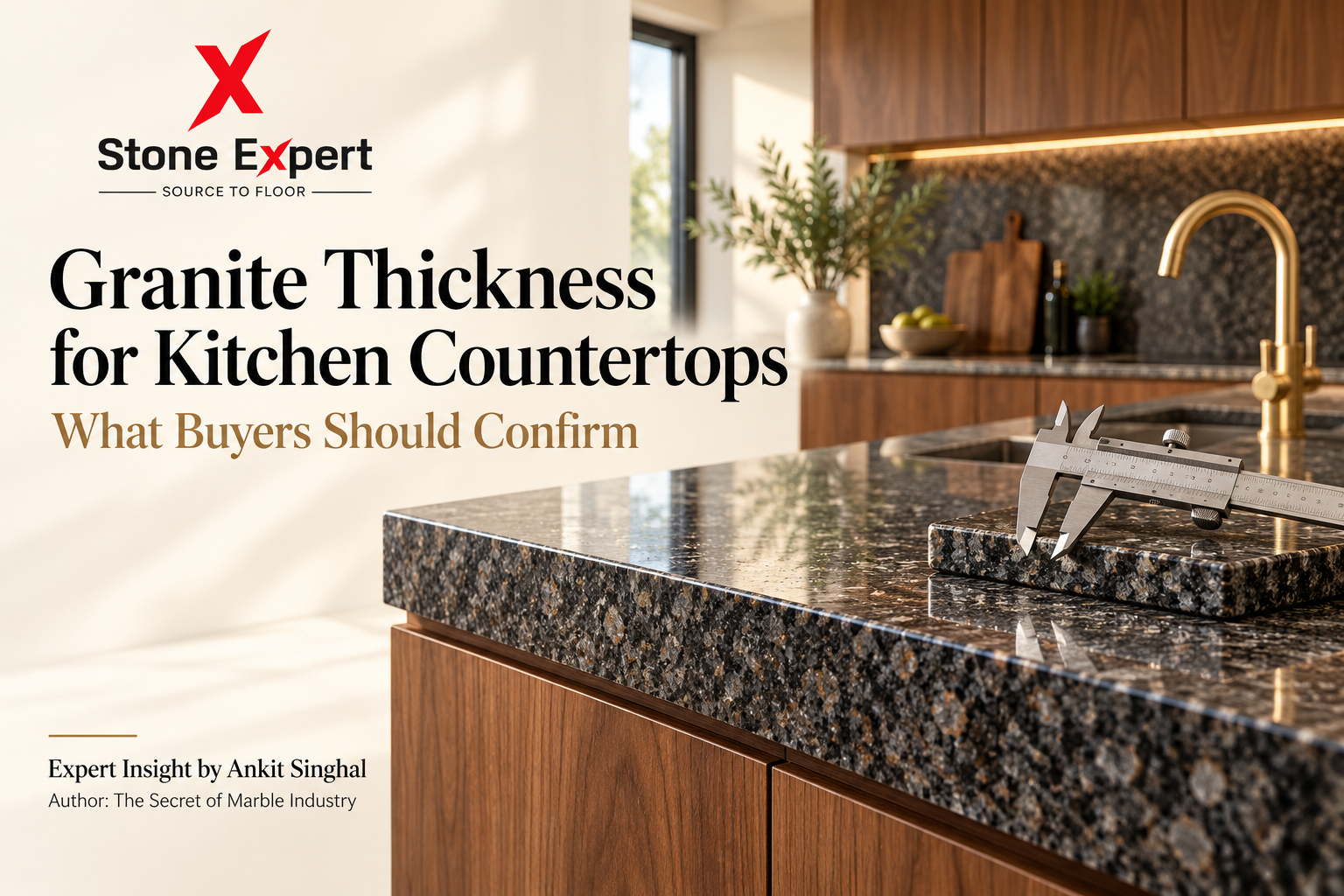
Granite thickness for kitchen countertops affects fabrication, support requirements, edge detailing, and your final quotation. However, choosing by thickness alone can leave important installation questions unanswered. Before ordering, confirm the actual slab measurement, cabinet condition, sink layout, and finished edge design.
Whether you are renovating an apartment or planning a villa kitchen, approve the stone and installation details together.
Which Granite Countertop Thickness Should You Choose?
You may encounter 18 mm, 20 mm, and 30 mm granite slabs. However, these options are not interchangeable in every kitchen.
| Slab thickness | What buyers should confirm |
|---|---|
| 18 mm | Have the fabricator approve the slab, substrate, and support arrangement for the actual layout. |
| 20 mm / 2 cm | Confirm cabinet support, cut-outs, seams, and whether the selected stone needs a subtop. |
| 30 mm / 3 cm | Check cabinet load capacity, handling access, and support beneath overhangs. |
The Natural Stone Institute explains that sound granite at 20 mm or greater can generally be installed without a full subtop. Nevertheless, weak veins, cracks, or excessive fissuring can require one regardless of thickness. Therefore, ask your fabricator to assess the actual slab. naturalstoneinstitute.org
For broader selection advice, explore Stone Expert’s thickness, grade and finishing guide.
Measure Actual Granite Thickness Before Ordering
First, ask the supplier to measure several accessible points with a suitable thickness gauge. Record the agreed finished thickness and acceptable variation in writing.
Also, clarify whether “20 mm” describes a nominal size or the measured finished slab. A verbal description should not replace an agreed specification.
Finally, check that adjoining pieces have compatible thicknesses. Otherwise, fabrication becomes more complicated, particularly around visible seams and exposed edges.
Check Cabinet Support and Kitchen Layout
Even a thicker slab needs a suitable base. Therefore, your installer should check that cabinets are level, securely fixed, and capable of carrying the countertop.
Next, identify unsupported areas above appliances, corner units, and seating spaces. Breakfast-counter overhangs may need brackets or another designed support arrangement.
Do not assume that 30 mm granite permits any overhang. Instead, have the fabricator confirm support positions according to the stone, dimensions, and intended use. The Natural Stone Institute’s guidance treats unsupported spans and overhangs separately. naturalstoneinstitute.org
Confirm Sink and Hob Cut-Out Details
Sink and hob openings remove material from the slab. Consequently, the remaining strips around these openings deserve particular attention.
Before fabrication, share the appliance templates and approve the cut-out positions. Also, confirm corner detailing, seam locations, and any reinforcement the fabricator specifies.
For an undermount sink, agree on a suitable mounting system. The installation plan should explain how the sink and its contents will be supported.
Understand Built-Up Granite Edges
A thick-looking edge does not necessarily indicate a thick slab. For example, a fabricator may join an additional strip beneath the front edge.
This detail can create the desired appearance. However, it does not turn the entire countertop into a slab of that visible thickness.
Therefore, request separate specifications for slab thickness and finished edge depth. Additionally, approve a sample showing the joint, polish, and profile.
Select the Actual Slab and Compare Complete Costs
Colour matters, but slab condition matters too. Inspect the surface, underside, repaired areas, and pattern before approving fabrication.
If you prefer a light kitchen palette, explore Alaska White Granite. However, confirm the actual lot’s thickness and suitability rather than choosing from a product photograph alone.
For personalised help, use Stone Expert’s material selection consultation.
Compare quotations covering stone, cutting, edge polishing, cut-outs, supports, transport, installation, and taxes. Also, clarify wastage, sealing where required, and responsibility for transit damage.
Frequently Asked Questions
Is 18 mm granite suitable for kitchen countertops?
It may be suitable with an appropriate support system. However, the fabricator must approve the actual slab and kitchen layout.
Is 30 mm granite always better?
No. It offers a thicker section, but support, slab condition, fabrication, and cabinet capacity still matter.
What should I confirm before paying?
Confirm the actual slab, measured thickness, edge detail, cut-outs, support plan, and complete installed quotation.
Contact Stone Expert
Share your kitchen drawing, measurements, and slab photographs through the Stone Expert contact page.
Phone / WhatsApp: +91 92521 01111
Email: ceo@shreeramexpo.in
Location: Kishangarh, Rajasthan
Website: www.stoneexpert.in