
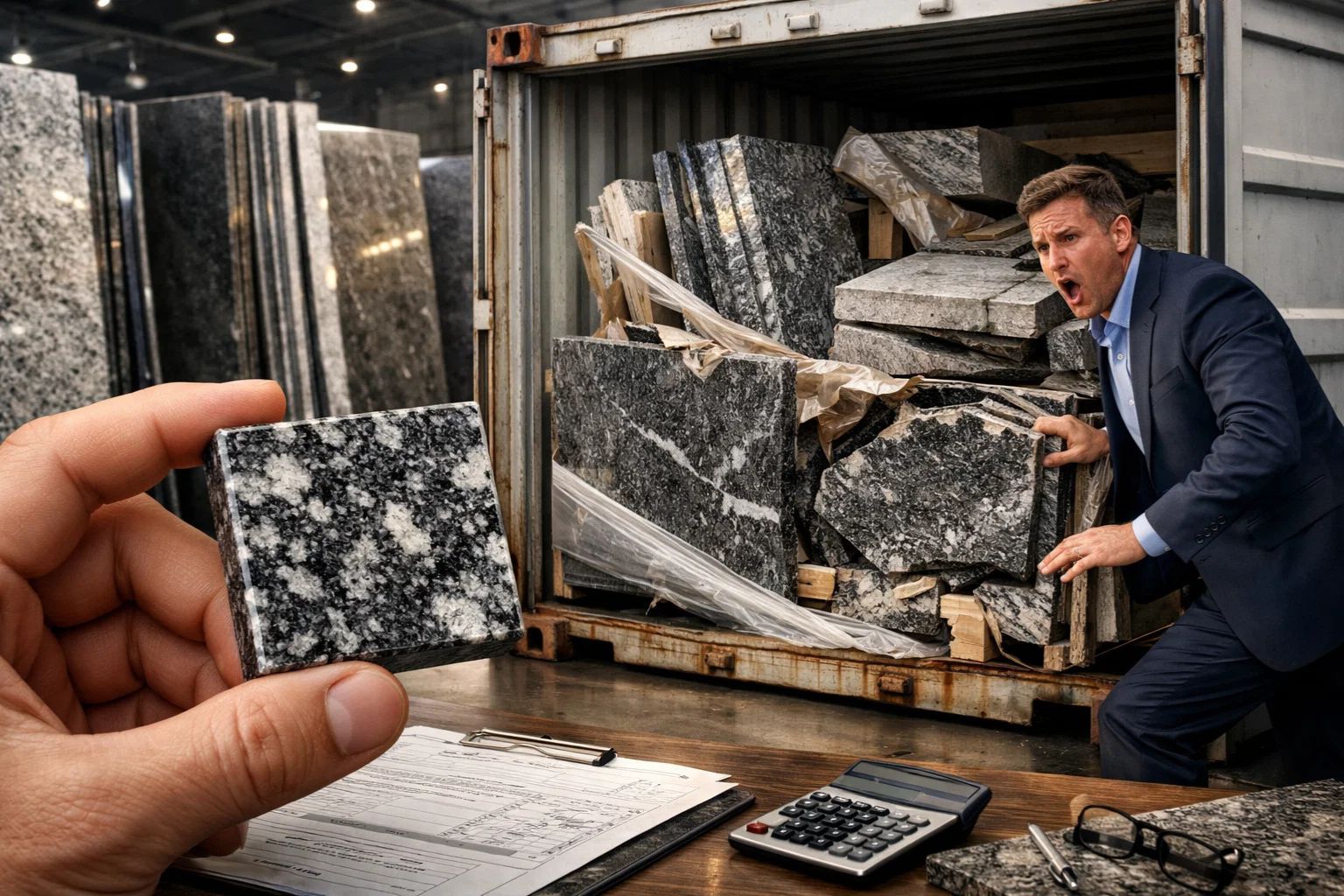
Buying granite for international projects can be profitable and rewarding, but many importers, builders, wholesalers, and contractors face one common risk — receiving a shipment that looks very different from the approved sample. This is one of the most common export scams in the natural stone industry.
A polished sample may look premium, uniform, and flawless. But when the container arrives, the granite may have different shade variation, cracks, poor polishing, uneven thickness, patched areas, or lower-grade slabs. This creates financial loss, project delays, customer complaints, and reputation damage.
In this expert guide, Stone Expert Ankit Singhal, author of THE SECRETS OF MARBLE INDUSTRY, explains how fake granite samples vs actual shipment scams happen, warning signs to watch, and how serious buyers can protect themselves.
What is the Fake Granite Sample Scam?
This scam usually starts when a supplier sends attractive small granite samples or photos. These samples may be:
- Handpicked premium pieces
- Extra polished showroom quality pieces
- Crack-free and uniform color samples
- Imported from another batch
- Not from actual production stock
Once the buyer confirms the order, the final shipment may include:
- Mixed quality slabs
- Color mismatch bundles
- Thin thickness material
- Resin-filled cracks
- Weak packing
- Damaged edges
- Low gloss finish
- Commercial grade instead of premium grade
This gap between approved sample and actual shipment is where buyers lose money.
Why This Scam is Common in Granite Export
Granite is a natural material. Every block has variation in:
- Color tone
- Grain movement
- Spot pattern
- Mineral lines
- Hardness
- Polish response
Unscrupulous exporters misuse these natural variations as an excuse after sending poor material.
They may say:
- “Granite always varies naturally.”
- “Same quality, only little shade difference.”
- “Next shipment will be better.”
- “This is normal export quality.”
But real professionals know the difference between natural variation and intentional cheating.
Real Problems Buyers Face
1. Sample Was Dark Black, Shipment Was Greyish
Very common in black granite orders where sample looked deep jet black but container had dull grey tone.
2. Sample Was Mirror Polish, Shipment Was Dull
Small sample polished with extra care, but bulk slabs had poor machine finish.
3. Sample Was Thick, Shipment Was Undersized
Order for 20 mm may arrive at 17–18 mm average thickness
4. Sample Had No Cracks, Shipment Had Filled Cracks
Resin and mesh backing may hide internal weakness.
5. Same Name, Different Quarry Source
Granite trade names are often reused. Same name does not always mean same quarry quality.
Biggest Warning Signs Before Payment
If a supplier does these things, be careful:
- Gives very cheap price compared to market
- Refuses live video inspection
- Avoids factory visit
- No clear slab photos after production
- Wants full advance quickly
- Changes company name frequently
- No export history
- Poor communication after advance payment
- No thickness tolerance details
- No written quality agreement
How Genuine Granite Exporters Work
Professional exporters usually provide:
- Lot-wise slab photos
- Bundle numbering
- Video inspection before loading
- Thickness checking reports
- Clear polish finish photos
- Packing photos
- Final container loading photos
- Shade confirmation
- Written invoice specs
- Fast communication
That transparency reduces disputes.
How to Protect Yourself Before Ordering Granite
1. Approve Full Slab Photos, Not Tiny Samples
Never finalize only on 4×4 inch sample pieces. Ask for full slab images.
2. Ask for Video Under Daylight
Indoor light can hide defects. Natural daylight reveals true shade.
3. Mention Thickness Tolerance in Writing
Example:
- 20 mm ± 1 mm
- 30 mm ± 1.5 mm
4. Define Quality Terms Clearly
Mention:
- No major cracks
- No excessive resin line
- Uniform polish
- Commercial / Premium / Export grade
5. Third Party Inspection
Independent inspection before loading can save large losses.
6. Partial Payment Terms
Avoid 100% advance to unknown suppliers.
7. Ask Packing Photos
Poor packing causes corner breakage and edge damage.
Best Granite Buying Method for Importers
A safer buying system:
- Select supplier carefully
- Approve exact slabs or lot photos
- Written specifications
- Production updates
- Video inspection
- Balance payment after approval
- Container loading proof
- Shipment tracking
This method minimizes risk.
Why Small Buyers Face Bigger Risk
Small importers often order first container based only on WhatsApp photos. They chase lowest price and skip inspection. Scam suppliers target these buyers because they know legal recovery across countries is difficult.
Cheap price can become expensive when:
- Material gets rejected
- Recut required
- Installation delayed
- Clients cancel orders
- Freight wasted
- Replacement shipment needed
Expert Advice from Ankit Singhal
According to stone expert Ankit Singhal, many granite disputes happen not because granite is bad, but because buyers trust incomplete information.
His recommendation:
- Buy from reputation, not only price
- Verify stock physically or digitally
- Use written contracts
- Keep quality evidence
- Choose long-term suppliers
This practical approach saves money and stress.
Why Reading THE SECRETS OF MARBLE INDUSTRY Helps
The book THE SECRETS OF MARBLE INDUSTRY shares insider knowledge on:
- Stone pricing tricks
- Quality grading truth
- Export buying methods
- Hidden margins
- Supplier selection
- Common scams
- Negotiation strategy
Useful for importers, architects, builders, dealers, and serious buyers.
5 Star Customer Reviews
⭐⭐⭐⭐⭐ David M., UAE
This guide helped us avoid a wrong granite container booking. Very practical and honest information.
⭐⭐⭐⭐⭐ James R., USA
We learned to ask for slab videos and thickness reports. Saved thousands in risk.
⭐⭐⭐⭐⭐ Ahmed K., Saudi Arabia
Excellent explanation of fake sample scams. Every importer should read this.
⭐⭐⭐⭐⭐ Rahul S., India
Simple language, expert advice, and real market truth. Highly recommended.
⭐⭐⭐⭐⭐ Peter L., Kenya
Professional insights from Ankit Singhal helped us choose a reliable supplier.
Frequently Asked Questions (FAQs)
Q1. Can granite samples differ from final shipment naturally?
Yes, slight variation is normal. Major mismatch in shade, polish, thickness, or defects is not acceptable.
Q2. Is cheap granite always risky?
Not always, but extremely low prices often indicate lower quality or hidden issues.
Q3. Should I inspect before shipment?
Yes. Pre-shipment inspection is one of the best protections.
Q4. Can photos be misleading?
Yes. Lighting, angle, filters, and selective images can hide defects.
Q5. How do I verify a granite exporter?
Check export history, reviews, communication quality, production proof, and transparency.
Q6. What payment method is safer?
Structured payment with milestones is safer than full advance to unknown suppliers.
Final Words
The fake granite sample vs actual shipment scam is real, costly, and common in global stone trade. Smart buyers focus on verification, documentation, and trusted suppliers instead of chasing the lowest quote.
If you buy professionally, inspect carefully, and work with experts, granite importing can be highly successful.
Contact Us
Stone Expert Guidance by Ankit Singhal
📞 +91 92521 01111
📧 ceo@shreeramexpo.in