
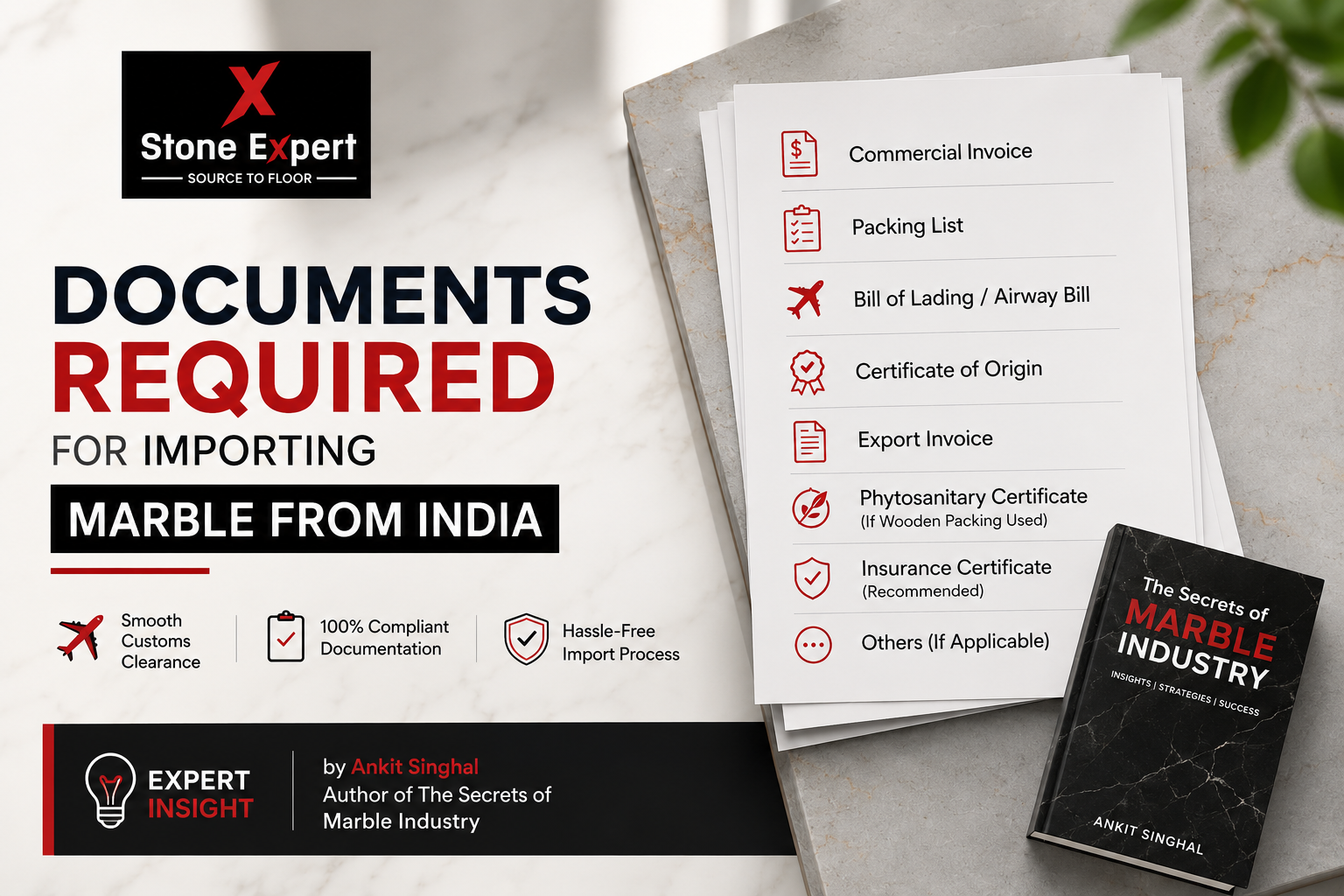
Importing marble from India offers excellent quality, competitive pricing, and a wide product range. However, successful international trade depends on accurate documentation. Every importer should understand the required paperwork before placing an order. Proper documents reduce customs delays, prevent extra charges, and ensure smooth delivery.
Whether you import Italian marble, Indian marble, granite, or natural stone, preparing the correct documents is essential for hassle-free shipping.
Why Documentation Matters in Marble Imports
International shipping follows strict customs regulations. Therefore, every shipment must include legally required documents. Accurate paperwork speeds up customs clearance and minimizes risks.
Additionally, complete documentation helps buyers verify product quality, payment terms, and shipment details.
Commercial Invoice
The commercial invoice is the most important export document. It provides complete information about the transaction.
The invoice generally includes:
- Exporter and importer details
- Invoice number and date
- Marble description
- HS Code
- Quantity
- Unit price
- Total value
- Country of origin
- Payment terms
- Currency used
Customs authorities use this document to calculate import duties and taxes.
Packing List
A packing list describes how the marble is packed for shipment. It allows customs officers and logistics companies to verify cargo quickly.
The packing list usually contains:
- Number of crates
- Bundle identification
- Dimensions
- Net weight
- Gross weight
- Package markings
- Product sizes
This document also helps buyers inspect shipments upon arrival.
Bill of Lading (B/L)
The Bill of Lading acts as the official shipping document. The shipping line issues it after loading the cargo.
It serves several important purposes:
- Proof of shipment
- Ownership of goods
- Transport contract
- Cargo tracking reference
Without the Bill of Lading, buyers cannot claim their shipment at the destination port.
Certificate of Origin
The Certificate of Origin confirms that the marble was produced or processed in India.
Many countries require this certificate to determine:
- Applicable import duties
- Trade agreement benefits
- Customs compliance
Government-authorized organizations usually issue this document.
Export Packing Declaration
Many importing countries request a packing declaration. This document confirms that export packaging complies with international quarantine standards.
It may include details about:
- Wooden packaging treatment
- ISPM-15 compliance
- Fumigation status
Proper packaging prevents quarantine issues during customs inspections.
Fumigation Certificate
If wooden crates are used, a fumigation certificate may be mandatory.
The certificate verifies that wooden packaging has been treated against pests. Consequently, many countries approve cargo only after receiving this document.
Always confirm destination country requirements before shipping.
Insurance Certificate
Marine insurance protects marble shipments against transit risks.
The insurance certificate includes:
- Cargo value
- Insurance coverage
- Policy number
- Shipment details
Although optional in some cases, insurance provides financial security during international transport.
Letter of Credit or Payment Documents
Payment documents depend on the agreed payment method.
Common payment options include:
- Letter of Credit (LC)
- Telegraphic Transfer (TT)
- Advance Payment
- Documents Against Payment (D/P)
Banks review these documents before releasing funds.
Inspection Certificate
Some buyers request third-party inspection before shipment.
Inspection agencies verify:
- Marble quality
- Quantity
- Dimensions
- Surface finish
- Packing quality
This certificate increases buyer confidence and reduces disputes.
Import License
Certain countries require import licenses before customs clearance.
Importers should verify local regulations before placing orders. This step avoids unnecessary delays after shipment arrives.
Additional Country-Specific Documents
Some destinations request additional paperwork depending on local regulations.
These documents may include:
- Health and Safety Certificates
- Phytosanitary Certificates
- Test Reports
- Quality Certificates
- Customs Declaration Forms
Requirements vary by country. Therefore, importers should consult their customs authority before shipping.
Tips for Smooth Marble Import From India
Successful imports require careful planning. Therefore, buyers should prepare all documents before cargo leaves India.
For a smooth importing process:
- Verify supplier credentials.
- Confirm HS Codes.
- Review invoice details carefully.
- Check destination customs regulations.
- Purchase marine insurance.
- Request inspection before shipment.
- Keep digital copies of every document.
- Coordinate with a reliable customs broker.
These steps reduce delays and improve overall shipping efficiency.
Choose a Trusted Marble Exporter
Working with an experienced exporter simplifies international shipping. Reliable suppliers provide complete export documentation and professional logistics support.
A trusted exporter also assists with packaging, customs paperwork, quality inspection, and international freight coordination. Consequently, buyers receive their marble safely and on time.
Whether importing marble for residential, commercial, or wholesale projects, complete documentation ensures a successful import experience.
Contact Information
Stone Expert
Address: Makrana Road, RIICO Industrial Area, Kishangarh, Khatoli, Rajasthan – 305801, India
Phone:
+91 92521 01111
Email:
ceo@shreeramexpo.in
shreeramexpo@gmail.com