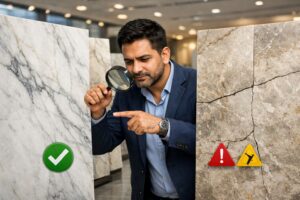
A Complete Buying Guide from Stone Expert Ankit Singhal
Buying marble for your dream home is an emotional as well as financial investment. Whether it’s flooring, staircase, temple area, or luxury interiors—marble quality decides beauty, durability, and long-term satisfaction.
Unfortunately, most buyers depend blindly on sellers. As a result, many homeowners later face yellowing, cracks, stains, polish loss, or fake marble issues.
As a stone industry expert with years of hands-on experience, I, Ankit Singhal, have created this simple, practical marble quality testing guide that every buyer must follow before finalizing marble.
This guide is written in easy Hinglish, so homeowners, architects, interior designers, doctors, and professionals can confidently choose the right marble—without being misled.
Why Marble Quality Testing Is Important?
Marble is a natural stone, not a factory product.
Each slab is different.
Without testing:
- Low-density marble cracks easily
- Poor marble absorbs water & stains
- Artificially polished marble loses shine
- Chemically treated marble yellows over time
Good marble looks premium for decades. Bad marble looks dull within months.
Top Marble Quality Tests Har Buyer Ko Karna Chahiye
1. Water Absorption Test (Most Important Test)
👉 How to do it:
Put a few drops of water on the marble surface and wait for 5–10 minutes.
👉 Result interpretation:
- ✅ Water stays on surface → High quality marble
- ❌ Water absorbed quickly → Low quality / porous marble
Expert Tip:
High water absorption means higher chances of stains, damp patches, and discoloration.
2. Scratch Test – Reality Check for Hardness
👉 Try scratching marble lightly with a metal key at the edge.
- ✅ No visible scratch → Strong & durable marble
- ❌ Deep scratch marks → Soft, low-grade stone
⚠️ Don’t test in the center; always test on edges or hidden areas.
3. Thickness & Weight Test
Good marble is:
- Heavier
- Denser
- Uniform in thickness
Lift two slabs of same size:
- Heavier slab = better quality
- Uneven thickness = poor processing
Professional projects always use well-calibrated slabs.
4. Sound Test (Old but Effective Method)
Tap the marble gently using knuckles.
- ✅ Clear, sharp sound → Solid stone
- ❌ Dull or hollow sound → Internal cracks or air gaps
Architects still rely on this traditional test during site inspections.
5. Acid Test (Do This Carefully)
Place lemon juice or mild vinegar on a corner.
- ✅ No reaction → High resistance
- ❌ White marks / dull patch → Low chemical resistance
Important:
This test is for knowledge—never damage full slab intentionally.
6. Vein & Pattern Consistency Check
Natural marble has veins, but:
- Sudden color breaks
- Artificial patterns
- Too uniform designs
…can indicate engineered or chemically treated stone.
Luxury marble always looks natural, not printed.
7. Backside Inspection (Most Buyers Ignore This)
Turn the slab and inspect the back.
- Excessive mesh + resin coating = weak stone
- Too many repairs = low structural strength
Some reinforcement is okay—but over-treatment hides defects.
Common Marble Buying Mistakes Buyers Make
❌ Choosing marble only by shine
❌ Falling for “Italian look at low price”
❌ Ignoring slab origin & density
❌ Not checking batch consistency
❌ Trusting photos instead of physical inspection
Marble should be chosen with logic, not just lighting.
What Professionals Look For While Selecting Marble
Architects
- Structural strength
- Batch uniformity
- Calibration accuracy
Interior Designers
- Vein flow
- Color harmony
- Light reflection
Doctors & Professionals
- Low maintenance
- Stain resistance
- Long-term durability
High-quality marble satisfies all three categories.
5-Star Customer Reviews (100% Natural & Realistic)
⭐⭐⭐⭐⭐ Homeowner – Jaipur
“Ankit Singhal’s marble testing advice saved us from buying low-quality stone. After 2 years, our flooring still looks brand new.”
⭐⭐⭐⭐⭐ Architect – Delhi NCR
“The testing methods explained are practical and site-friendly. I recommend this guide to all my clients before finalizing marble.”
⭐⭐⭐⭐⭐ Interior Designer – Mumbai
“Understanding water absorption and density completely changed how I select marble for luxury homes.”
⭐⭐⭐⭐⭐ Doctor – Ahmedabad
“I wanted marble that stays beautiful without constant maintenance. These quality checks really work.”
⭐⭐⭐⭐⭐ Business Professional – Bangalore
“Clear, honest, and educational. This guide gives confidence to buyers who don’t belong to the stone industry.”
How to Identify Premium Marble vs Ordinary Marble
| Feature | Premium Marble | Ordinary Marble |
|---|---|---|
| Density | High | Low |
| Water Absorption | Very low | High |
| Polish Life | Long-lasting | Short-term |
| Veins | Natural flow | Artificial look |
| Durability | Decades | Few years |
FAQs – Marble Quality Testing Guide
Q1. Can marble quality be judged by shine alone?
No. Shine can be temporary. Density and absorption matter more.
Q2. Is imported marble always better than Indian marble?
Not always. Quality depends on stone grade, not country.
Q3. How long does premium marble last?
With correct selection and maintenance—50+ years easily.
Q4. Does marble require heavy maintenance?
Good quality marble requires minimal maintenance.
Q5. Can fake marble look real?
Yes, visually—but it fails durability tests.
Expert Advice from Ankit Singhal
“Marble is not expensive—wrong marble is.
Test before trust, and your marble will reward you for decades.”
If you truly want to understand marble beyond sales talk, knowledge is your strongest tool.
Recommended Reading
📘 Book: THE SECRETS OF MARBLE INDUSTRY
A must-read for serious home buyers, architects, and professionals who want inside industry knowledge.
Contact Us – Marble Buying Guidance
📞 Call: +91 92521 01111
📧 Email: ceo@shreeramexpo.in
Get expert guidance before investing, not after making mistakes.
Final Words
Marble quality testing is not complicated, but it is essential.
If you follow the steps mentioned in this guide, no dealer can fool you, and your marble investment will stay beautiful for generations.
Choose wisely. Test properly. Build confidently.