
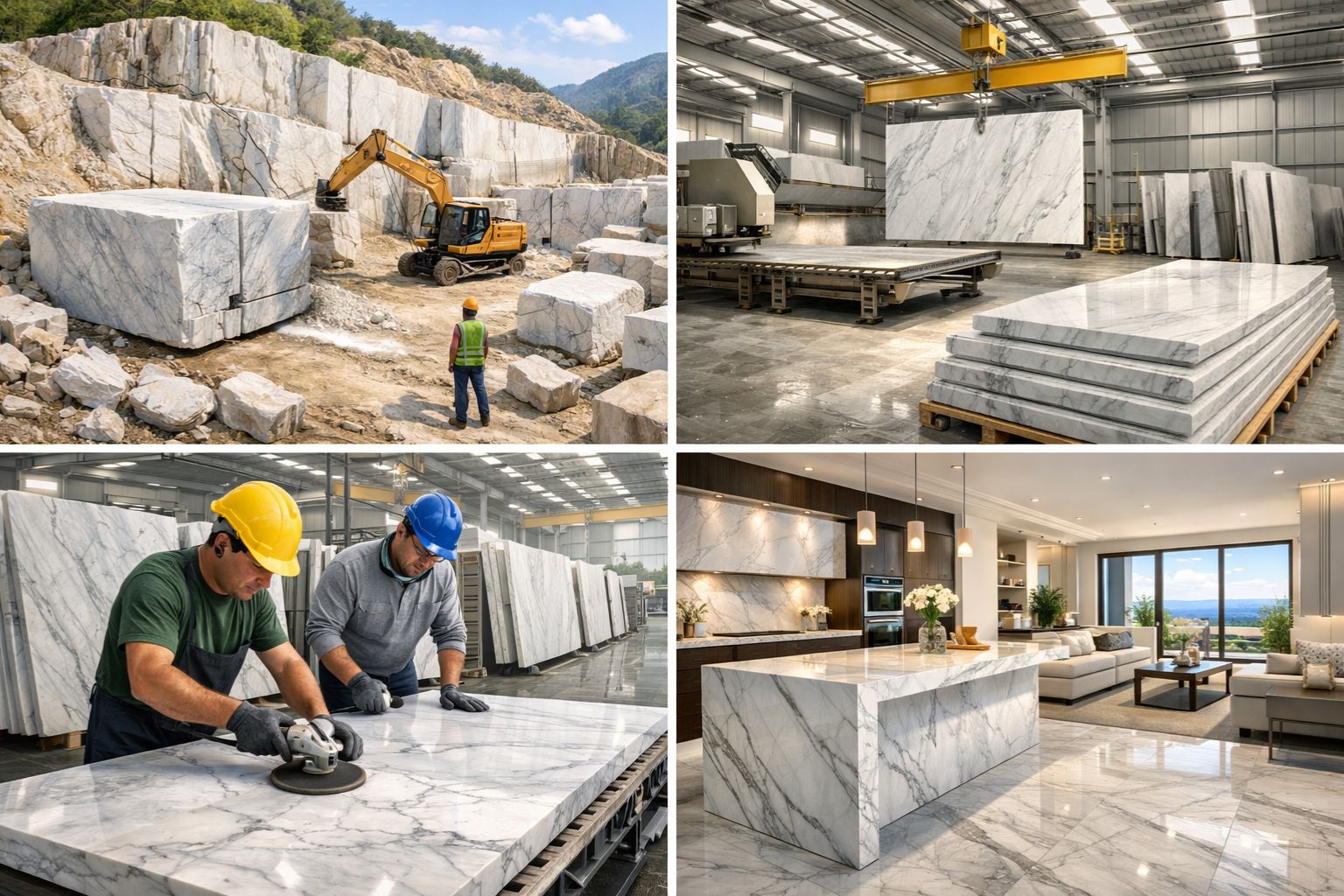
Marble has been admired for centuries as a symbol of luxury, strength, and timeless beauty. From ancient monuments to modern luxury homes, marble continues to define elegance. But have you ever wondered how marble is made and how it travels from deep inside the earth to the floors, walls, and countertops of your home?
As a stone expert, Ankit Singhal, with decades of hands-on experience in the natural stone industry, this guide explains the complete marble journey—from quarry to home in a simple, transparent, and user-friendly way.
Whether you are a homeowner, architect, builder, or stone enthusiast, this guide will help you understand marble like never before.
What Is Marble? Understanding Its Natural Origin
Marble is a natural metamorphic stone formed when limestone undergoes intense heat and pressure over millions of years beneath the earth’s surface. This geological transformation changes limestone into a dense, crystalline stone with unique veining patterns.
Each marble slab is naturally unique, making it impossible to replicate its design artificially.
Key Characteristics of Natural Marble:
- Elegant natural veining
- Smooth crystalline texture
- High durability and strength
- Ability to reflect light beautifully
- Naturally cool surface, ideal for Indian climates
Step 1: Marble Formation Inside the Earth
The journey of marble begins millions of years ago.
- Limestone deposits accumulate at the bottom of seas and oceans
- Over time, tectonic movement pushes these deposits deep underground
- Extreme heat and pressure recrystallize limestone into marble
- Minerals like graphite, iron oxide, and quartz create unique veins and colors
This natural process makes marble one of the most premium stones on earth.
Step 2: Identifying High-Quality Marble Deposits
Not all marble deposits are suitable for architectural or interior use. Expert geologists and stone specialists identify quarries based on:
- Stone density and hardness
- Veining consistency
- Color clarity and purity
- Structural integrity
- Commercial block size availability
Only selected marble reserves are approved for large-scale extraction.
Step 3: Marble Quarrying – Extracting Stone from the Earth
Marble quarrying is a highly technical and precise operation. Modern quarrying focuses on preserving block quality while minimizing waste.
Quarrying Process:
- Geological surveys mark extraction zones
- Diamond wire saws cut massive marble blocks
- Controlled techniques prevent cracks or fractures
- Blocks weighing 10–25 tons are carefully removed
Today’s advanced quarrying methods ensure environmentally responsible extraction while maintaining stone quality.
Step 4: Transporting Raw Marble Blocks to Processing Units
Once extracted, raw marble blocks are transported using heavy-duty trucks to processing units.
During transportation:
- Blocks are carefully secured to avoid damage
- Moisture exposure is controlled
- Each block is labeled for traceability
This stage is crucial to maintain natural stone integrity.
Step 5: Marble Cutting – From Blocks to Slabs
At the processing unit, large marble blocks are transformed into slabs.
Cutting Methods:
- Gang saw machines with multiple blades
- Diamond wire cutting technology
- Precision thickness control
Standard slab thickness:
- 16–18 mm (interiors & wall cladding)
- 20 mm (flooring)
- 30 mm (countertops & staircases)
Step 6: Surface Finishing – Enhancing Marble Beauty
Marble finishing determines the final look and usability of the stone.
Popular Marble Finishes:
- Polished: High gloss, luxury finish
- Honed: Smooth matte surface
- Leathered: Soft textured look
- Brushed: Antique appearance
- Sandblasted: Slip-resistant surface
Polishing enhances natural veining and increases reflectivity.
Step 7: Quality Inspection & Grading
Every marble slab undergoes strict quality checks.
Quality Parameters:
- Color uniformity
- Vein consistency
- Surface cracks or fissures
- Thickness accuracy
- Polishing level
Slabs are graded to help buyers choose according to design and budget.
Step 8: Marble Customization & Cutting for Homes
Before installation, marble is customized according to project needs.
- Size cutting for floors, walls, and countertops
- Edge profiling (beveled, bullnose, ogee)
- Book-matching and vein-matching
- CNC cutting for artistic designs
This step ensures perfect alignment and seamless aesthetics.
Step 9: Packing & Safe Delivery
Marble is fragile if mishandled. Proper packaging ensures safety during transit.
- Wooden crates for slabs
- Foam and plastic wrapping
- Vertical loading to prevent breakage
- Moisture protection
Professional handling ensures marble reaches homes in perfect condition.
Step 10: Marble Installation at Home
Correct installation defines marble’s lifespan and beauty.
Installation Best Practices:
- Perfectly leveled surface
- High-quality adhesive or cement
- Proper spacing for expansion
- Skilled labor for vein alignment
Expert installation ensures marble lasts for decades.
Step 11: Marble Polishing After Installation
Post-installation polishing:
- Enhances shine
- Removes micro scratches
- Seals surface pores
Periodic re-polishing keeps marble looking brand new.
Step 12: Marble Maintenance & Care Tips
Marble is easy to maintain if cared for properly.
Maintenance Tips:
- Clean with pH-neutral cleaners
- Avoid acidic liquids
- Use soft cloths
- Seal marble periodically
- Wipe spills immediately
Proper care extends marble life for generations.
Why Marble Is Still the King of Natural Stones
Marble continues to dominate luxury architecture because of:
- Timeless beauty
- Natural uniqueness
- Long-term value
- Compatibility with modern & classic designs
No artificial material can replace natural marble’s charm.
Expert Insight by Ankit Singhal
“Marble is not just a stone; it’s a legacy created by nature and perfected by craftsmanship. Understanding its journey helps buyers make informed, confident decisions.”
For deeper industry knowledge, explore my book:
📘 THE SECRETS OF MARBLE INDUSTRY
Frequently Asked Questions (FAQs)
1. How long does marble formation take?
Marble formation takes millions of years under natural heat and pressure.
2. Is marble suitable for Indian homes?
Yes, marble is ideal for Indian climates due to its cooling properties.
3. Does marble require high maintenance?
No, with basic care and sealing, marble is easy to maintain.
4. Can marble crack easily?
High-quality marble installed correctly is extremely durable.
5. What is the best finish for marble flooring?
Polished finish is most popular for luxury interiors, while honed is preferred for slip resistance.
6. Is marble eco-friendly?
Yes, marble is a natural, recyclable material with a long lifespan.
Contact Us – Expert Marble Guidance
For professional guidance, bulk orders, or marble consultation:
📞 Phone: +91 92521 01111
📧 Email: ceo@shreeramexpo.in
Get expert support directly from industry specialists.
Final Thoughts
Understanding how marble is made—from quarry to home gives you confidence while selecting stone for your space. Marble is not just a material; it’s an investment in beauty, durability, and timeless elegance.
When chosen wisely and installed professionally, marble transforms homes into masterpieces that last for generations.