
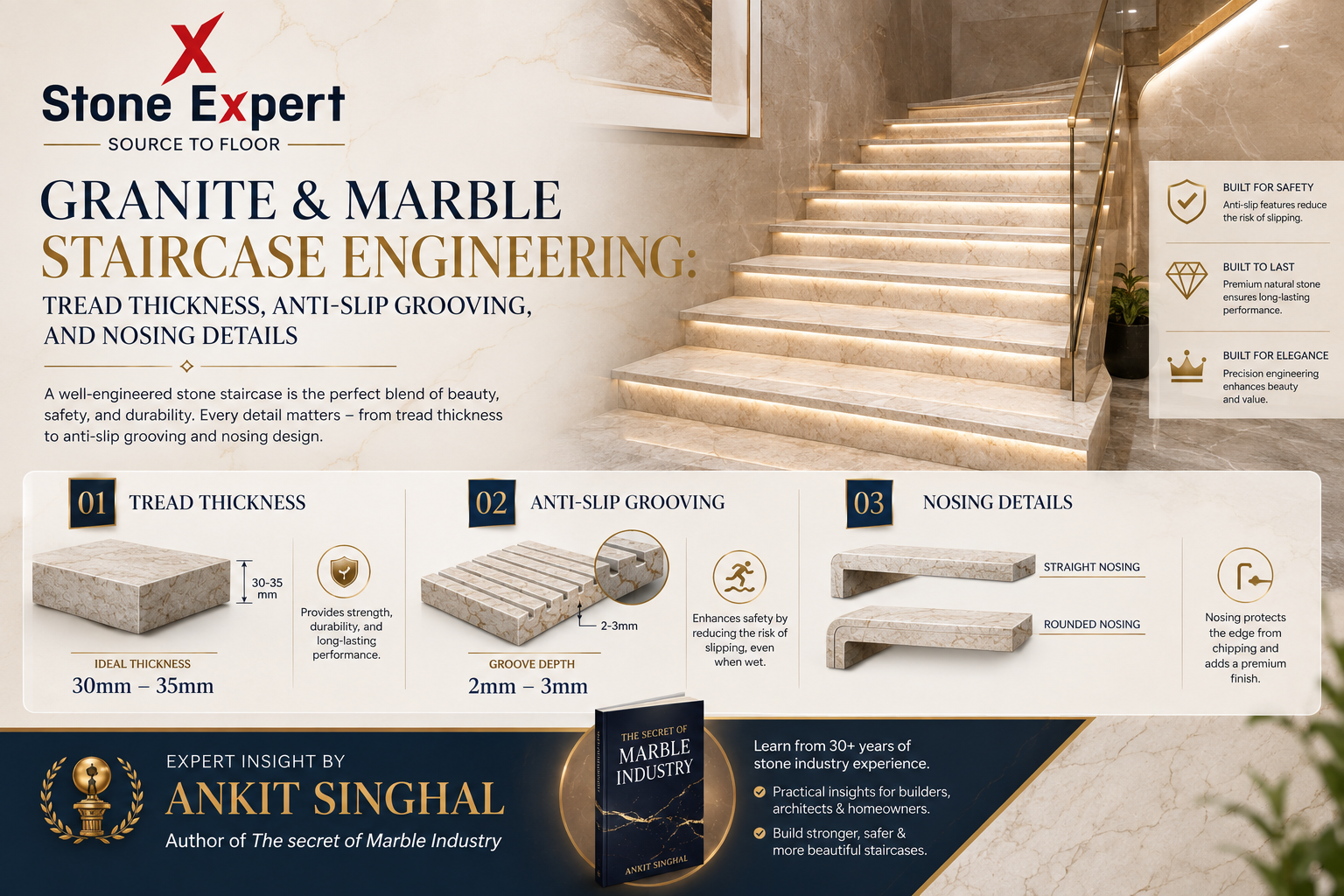
Granite and Marble Staircase Design
A stone staircase combines durability, safety, and architectural appeal. Granite and marble offer excellent choices for premium staircases. However, proper engineering remains essential for long-term performance.
The right staircase marble tread thickness improves strength and stability. Moreover, accurate nosing and anti-slip details improve everyday safety.
Before fabrication, measure every step carefully. Also, confirm the supporting structure and finished floor levels. This approach helps prevent alignment problems during installation.
Staircase Marble Tread Thickness
The correct staircase marble tread thickness depends on the staircase structure. Solid stone treads often require substantial thickness for reliable performance.
For supported marble treads, thickness commonly ranges around 18–25 mm. Heavier applications may require thicker stone or additional structural support.
Granite generally provides excellent resistance to daily wear. Marble, however, offers a more luxurious appearance and distinctive surface patterns.
For floating or cantilevered steps, structural calculations become especially important. In such applications, stone thickness alone does not determine load capacity.
Therefore, always coordinate stone dimensions with the staircase fabricator. The support system should carry the primary structural load.
Anti Slip Marble Groove Details
Polished marble can become slippery, especially when exposed to moisture. Consequently, anti slip marble groove details deserve careful attention.
Grooves can be positioned near the front edge of each tread. They create additional traction while maintaining an elegant appearance.
Common groove designs include straight lines, multiple parallel grooves, and recessed anti-slip strips. The final pattern should match the staircase’s overall design.
Grooves should remain consistent across every tread. Uneven spacing can reduce visual quality and create installation difficulties.
Additionally, groove depth should remain controlled. Excessive cutting can weaken the stone near the tread edge.
For premium projects, architects can combine subtle grooves with a honed or leather finish. This creates a balanced combination of safety and aesthetics.
Marble Staircase Nosing Details
Stair nosing protects the front edge of a tread from regular impact. It also creates a clear visual separation between individual steps.
A properly designed nosing should extend consistently across the staircase. The projection should suit the overall tread design and structural arrangement.
Bullnose profiles remain popular for residential and luxury interiors. They provide a softer edge and reduce the sharp appearance of square-cut stone.
For contemporary projects, a simple eased or pencil-edge profile can create a cleaner appearance. The best profile depends on the architectural style.
Full Bullnose vs Half Bullnose Marble Stair
Understanding full bullnose vs half bullnose marble stair profiles helps homeowners choose the right finish.
A full bullnose creates a rounded profile across the visible front edge. It provides a softer and more decorative appearance.
A half bullnose rounds the upper portion of the edge. The underside remains comparatively straight, creating a simpler profile.
Full bullnose profiles work well with classic and luxury interiors. Meanwhile, half bullnose profiles suit modern and minimal staircase designs.
Both profiles can provide attractive results when fabricated accurately. However, the selected profile should match the tread thickness.
Granite Stair Tread Engineering
Granite stair treads are popular because of their strength and durability. They also handle heavy foot traffic effectively.
Before cutting granite, fabricators should verify the exact tread dimensions. They should also account for nosing projections and joint positions.
Furthermore, the stone should receive proper edge finishing. Accurate polishing helps maintain a consistent appearance throughout the staircase.
Granite also offers numerous colors and patterns. Therefore, designers can coordinate stair treads with flooring, walls, and countertops.
Marble Staircase Installation Tips
Proper installation protects the stone and improves staircase performance. First, installers should check that the supporting surface is level.
Next, each tread should be dry-fitted before permanent fixing. This step helps identify dimensional issues early.
Use suitable stone installation materials for the selected substrate. Also, maintain consistent joints throughout the staircase.
Finally, inspect every nosing and groove after installation. Any sharp or uneven section should be corrected before handover.
Choosing the Right Stone Staircase Finish
The right finish depends on traffic, design, and maintenance requirements. Polished marble provides a luxurious appearance with strong visual depth.
Honed finishes offer a softer appearance and can provide additional surface grip. Leathered granite creates texture while maintaining a premium natural-stone character.
Therefore, consider both appearance and practical performance before selecting the final finish.
Why Choose Quality Marble and Granite Staircases?
A professionally engineered stone staircase can become a major architectural feature. Correct thickness provides stability, while precise grooves improve safety.
Likewise, carefully selected nosing profiles create a refined finished appearance. Together, these details deliver a staircase that looks premium and performs reliably.
For custom granite and marble staircase projects, choose experienced stone manufacturers and fabricators. Quality material selection and precise processing can significantly improve the final result.
Stylish Contact Information
Stone Expert
Premium Marble & Granite Manufacturer | Export Supplier
📍 Address: Makrana Road, RIICO Industrial Area, Kishangarh, Khatoli, Rajasthan – 305801, India
📞 Phone: +91 92521 01111
✉️ Email: ceo@shreeramexpo.in | shreeramexpo@gmail.com
🌐 Website: shreeramstones.com
FAQ
What is the ideal staircase marble tread thickness?
Marble tread thickness depends on the support structure and application. Common supported treads use approximately 18–25 mm stone.
Are anti-slip grooves suitable for marble stairs?
Yes. Properly designed grooves can improve traction while maintaining the marble’s visual appeal.
What is the difference between full bullnose and half bullnose?
Full bullnose creates a rounded front profile. Half bullnose rounds the upper edge while keeping the underside straighter.
Is granite suitable for staircase treads?
Yes. Granite offers excellent durability and performs well in high-traffic staircase applications.
Should marble stairs be polished?
Polished marble provides a luxurious appearance. However, honed finishes may offer a more practical surface for certain staircase applications.